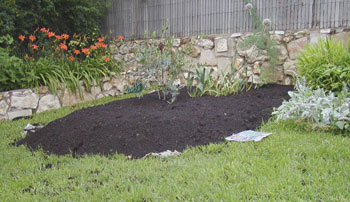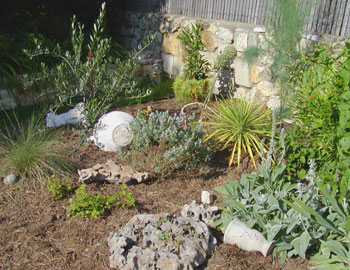
The little bush on the top left is a young olive tree. Rather than leave the site bare until it fulfills its ultimate role in maturity, I intend to enjoy the area around it as a sunny bed. As the little olive grows into a big tree, the site will accordingly evolve into a shady bed.
Most of the plants symbolically allude to the Grecian theme, while some just represent the feel of Greek scenery to me. The main idea is to capture the essence of the rural landscape, which has a feel much like Central Texas with herbs, grasses and shrubby things against sunny bare earth and rocks. We would occasionally catch the scent of sage and oregano while driving along winding mountainous roads. I never saw a bay laurel, but I am including one that’s been potted up on the patio for a couple of years. Same with the yucca that I just knew I’d need one day. Inspired by a friend’s suggestion, the bay commemorates coliseum victory wreaths. Achillea yarrow will be transplanted from another bed to grow below the little plaque hanging on the wall. Made from the magnesium-rich limestone hills around Athens, it is a relief of Achilles pulling the arrow from his heel. I brought back some other pieces too, but can’t bear to risk them being damaged outdoors.
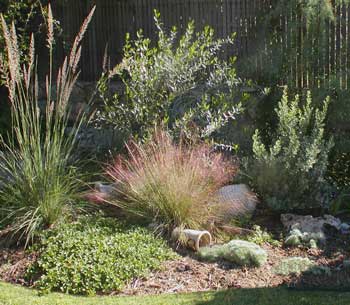
The other “ruins” have just been living in various places around the garden for many years. LOOK GAIL,, there’s Roland (aka David) again, nicely weathered and feeling right at home! The white circle thing is a bad angle of an old pot that long fell apart. It was made in the shape of … an olive jar (!) The lovely urn with metal ring handles is one we once carried in our web shop. The swiss cheese stones are from Central Texas and I will probably get around to putting more of my gardens white boulders in there shortly. The low ground cover is a clump of marjoram (having an essence much like that of Greek oregano) that I took out of the herb beds because it wasn’t getting enough sun there. I would also like to have some of the silver-leafed Greek oregano.
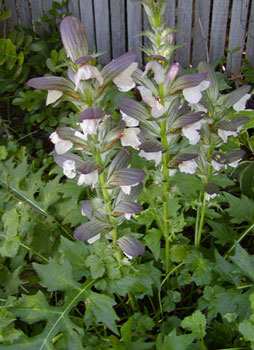
The on-order wall fountain to-come is of a weathered limestone finish. It will go against the stone wall, to the left of the ferny looking Tamerax bush. It was planted there 2 or 3 years ago and is just now taking off and will be groomed to weep over the fountain and soften the bare fence. Both the Tamerax and the Siverado sage bloom pink, so that pretty much establishes a pink and silvery color thread, which is nice with limestone gray. The Muhly grass will have its pinkie plumes in fall. In spring and summer there will be pink from the most significant (to me) plants, which are yet to be installed – Acanthus,,, tons of them around the front of the bed. Yes, those from which the leafy design on Corinthian columns are styled after. I mail ordered one a couple a years ago. It has proven itself happy here and is now in its 3rd bloom season, below.