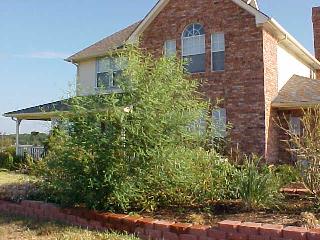
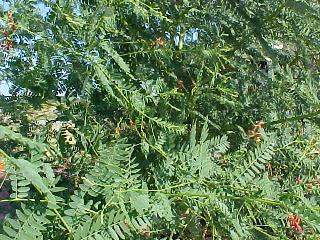
I am hoping someone will be able to identify this unknown tree which grew in the large raised bed. The foilage looks very much like a legume, and it has small red flowers. Its actually quite large, about 10-12 feet tall.
Whatever it is, it's hopperproof.  Got me beat with that one Carolyn.
It really is hopperproof. They light on it, but if they eat it, I can't tell. Its awfully pretty, and when it started making flowers, it really caught my attention. However, its a real mystery plant to me.
Do you think it came up from a seedling, or that it was planted by the prev owners?
My first impression was that the leaves looked a Sophora, such as Tx Mountain laurel and Eve's necklace, but the blooms are the wrong color for either.
There are some native Robinias with similar leaf formation - they have either white or dark pink blooms. Does it have brown bristles on the stems or a thorn on each leaf axis? Is the bloom like a pea flower?
Gotta close up of the bloom?
Just went out and looked and took more pics. Its pretty windy today, so I had to try to hold the branches still. No thorns. No the previous owners didn't plant it. The thing came up in the large raised bed we built last fall. Its in a section where we used fill dirt (from pool excavation dirt which was mostly clay subsoil). Maybe a bird dropped a seed? I'm clueless on the origin.
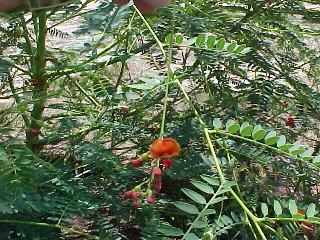
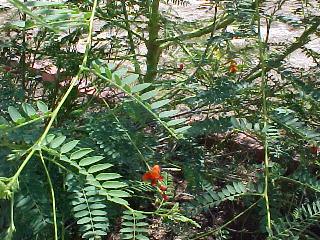
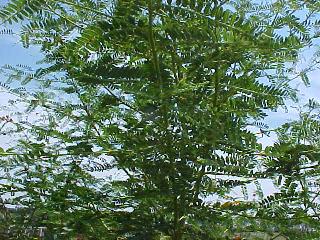
The closest thing I can find in my book (Plants for Texas, by H. Garrett) is Pistacia texana. However, the book says nothing about it having a smooth green bark, nor about the orange flowers. So.......
Suppose I should dry a leaf and a flower, and send to BRIT.
You might try Sesopnla palcherimma.......It is not a real winter hardy plant here........It can handle 25 or so but not +8 to +18...It will die to the ground.....I don't no the common name...but my Mother called it a rattle tree.....I hope this is it......
Didn't find that Latin spelling in any of my native plant books or Hortus. But think you may be on to it David. Found Sesbania punicea described as having orange-red blooms. (the S. drummondii has yellow flower)
From text in 'Wild Flowers of the Big Thicket' about the red one:
"infrequent to rare in East Texas and western Louisiana; native of So Amer"
Watch out for those self-sowing seeds Caro, it seems to like your place!
I didn't find David's spelling either. I'll look up what you found. Thanx to all for the help.
Good teamwork, Mags and David! That is exactly it. The authorities call it an exotic pest which means invasive weed. Well, its pretty, its green, its in a raised bed where the grasshoppers ate just about everything else, so I'll call it a hardy, pest and drought tolerant flowering tree.
Looks like a good weed to have around, and it's not like you are short on space Carolyn.
Sad news to report.  Was outside walking around with my coffee, and thought, "Hmmm. Something is not right." Only to realize that my weed tree was.........
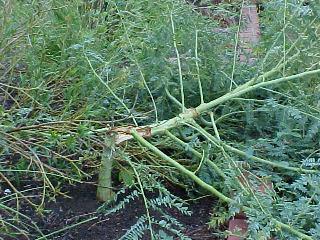
Those grasshoppers must be developing chainsaw jaws
Can you tell what caused it to break?
As fast as that plant grew this summer, it might be a nice bush again, real soon!
My god Carolyn what sort of flash do you have on that camera?
Maybe the trees demise is a blessing in disguise. From the look of the growth rate it would not have been long before it moved into the house and evicted you!
I would cut it off nicely and wait, it should come back next year if we don't get real COLD temps this winter....It is worth a try......Good Luck.....and sorry for your loss.....
Thanx. Good ideas. So far, with the rain we've been having, the broken weed tree is right where it fell. Maybe I'll just leave it and let it compost on the spot.
Carolyn, the "mystery tree" in your photos is a Caesalpinia, or Mexican Bird of Paradise. It is an ornamental tree, not an invasive weed. I hope you didn't destroy it.
Aww UI, you’re not so useless after all. Opening up this old thread gives me the chance to update it with pics of that plant in my garden. And I agree with you about it being a good ornamental in the right location. There are areas of the country were it has become a threat to the indigenous flora in open land. This problem seldom occurs in densely developed areas and suburban plantings.
Since the above posts were made, I was given a Sesbania punicea that appears to be the same as the one in above pics. Here it is in my long border. 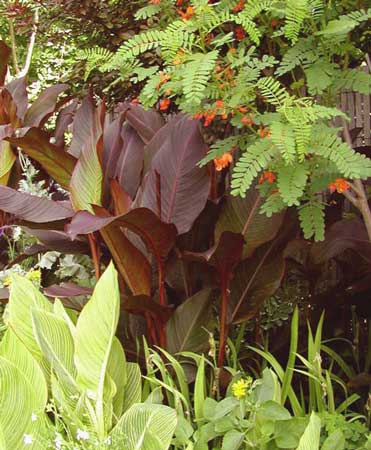
It is very similar to the Bird of Paradise, but is not a Caesalpinia gilliesii.
Here is pic link for ref
It is not Caesalpinia mexicana, aka Mexican Bird of Paradise - it doesn’t have the yellow blooms or the same leaves as that one. See pic here of C. mexicana
It is not Caesalpinia pulcherrima - Pride of Barbados (aka peacock flower, Barbados pride, dwarf poinciana, Barbados flower-fence, and which used to be known as a Poinciana before the taxonomists changed it).
Here’s pic link
I have grown all 3 of those and know them well.
It is still Sesbania punicea , commonly known as Rattlebox, because of the seedpods.
Here is a confirmation link
Its plant parts matches the Sesbania punicea in my garden, in everyway
Thanks for your input UI and the chance to clarify all those beautiful proud bird plants
Thanks for sharing that beautiful scene with us Maggie. It is truely a lesson in artful plant composition.