
Thrift
Phlox subulata
... for a spring blooming evergreen carpet
 |
Common names: Thrift, Moss Phlox, Mountain Phlox, Creeping Phlox
Latin Name: Phlox subulata
Form: The mat-forming evergreen perennial provides a durable groundcover.
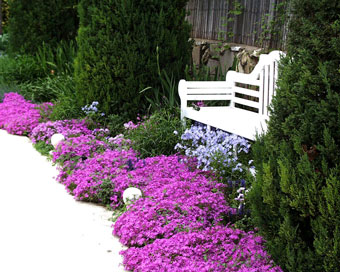
Design Tip: The resilient foliage and shallow root system of the plant is durable enough to live in the most rugged sites. It can cascade over sunny slopes and banks, cover French drain beds, ramble between stones in a rockery, frame paths, edge borders, front rose bushes and shrubbery, or drape over the top of low walls. When plants are spaced as separate clumps, rather than in a solid swath, they need other spring blooming or evergreen neighbors to avoid having brilliant spots look lonely in an otherwise spring-bare bed.
Size: Each plant spreads into a 1 to 3-foot wide mat, retaining a 2 to 3 inch height, which rises to 6 inches tall when in bloom.
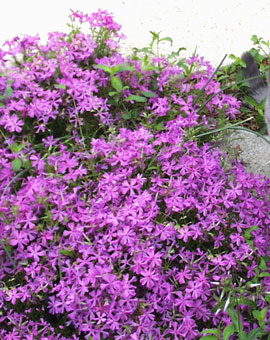
Flowers: Half-inch blooms of the species Phlox subulata are a vivid deep pink and there are cultivars in several shades of rosy red, soft pink, lavender, blue, and white. Five-petaled flowers cluster at the end of each stem, almost covering the entire plant with color for four to six weeks in March and April in the Metroplex climate.
Foliage: Half-inch long, evergreen juniper-like leaves densely cover prostrate stems, creating a mossy groundcover.
Soil: Although its natural habitat is usually an evenly moist, sandy or gravelly alkaline soil, the plant will tolerate a wide range of mediums, with excellent drainage. Well-established mature plants become reasonably drought tolerant.
Light Exposure: Preferring full sun, the wild form will tolerate hot, dry exposures better than other varieties. Some named cultivars prefer an afternoon shade in hot climes.
Hardiness: This native of northeastern United States, is hardy in USDA Zones 3-9.
Grooming: Shear back stems of plants by one-third to halfway, every two to three years, after spring bloom to promote vigorous new growths and to keep the ratio of roots to top growth in good proportion. Like lavenders, old woody plants tend to die of old age without pruning. The trimming can also be applied annually to keep a path or sidewalk clear of excess growths.
Propagation: New plants can be rooted from stem cuttings and root ball divisions can be made in spring or fall.
Snippets: Tidy mounds of spring bloom fill the garden with a musky perfume fragrance. Phlox is from the Greek for "flame" and subulata translates as "awl-shaped", referring to the foliage resemblance to some Junipers.
Return to Plant Profiles Index Page
 |
Cultivated, Photographed and written by
Maggie Ross McNeely in Fort Worth, Texas
All Rights Reserved